How to Match Your Chain & Pendant
Matching a chain with the right pendant is about balance. Get it right and the whole outfit looks intentional; get it wrong and even an expensive pendant looks like an afterthought. This guide covers everything — finishes, widths, lengths, layering, and the material questions Indian buyers ask us most often — so you can build a chain-and-pendant combination that looks sharp every single day.
Rule 1: Match the Finish
Keep metal finishes consistent: gold with gold, silver with silver, black with black. A gold pendant on a silver chain rarely looks deliberate — it looks like two pieces that happened to be in the same drawer.
If you want to experiment, mixed-metal looks can work, but keep it to two tones maximum for a clean result. The safest mixed pairings are:
- Silver + black — the easiest combination to pull off, works with almost any outfit
- Gold + black — bolder, suits streetwear and evening looks
- Silver + gold — the hardest to get right; works best when the pendant itself is two-tone, so the mix looks designed rather than accidental
One more finish detail people miss: matte vs polished. A matte black pendant on a high-shine polished chain creates a texture clash. Match the surface treatment as well as the colour. Browse our gold chains and black chains to see how a consistent finish family looks together, or start with the full chains collection.
Rule 2: Pair Width with Weight
Heavier pendants need wider chains for balance — both visually and physically. A heavy pendant on a thin chain will slide around, flip over, and put stress on the links. A tiny pendant on a chunky Cuban chain simply disappears.
Use this as your working table:
| Chain width | Best pendant style | Overall look | Wear it with |
|---|---|---|---|
| 2–3 mm | Minimal bars, small geometric motifs, initials | Subtle, everyday | Office shirts, plain tees |
| 4–5 mm | Mid-size motifs — stars, crosses, coins | Balanced, versatile | Casual and smart-casual |
| 6 mm+ | Bold statement pendants, iced-out pieces | Statement, streetwear | Hoodies, oversized fits |
A good practical test: hold the pendant against the chain before you buy. The pendant's bail (the loop it hangs from) should slide onto the chain easily but not swim on it. If the bail is much wider than the chain, size the chain up.
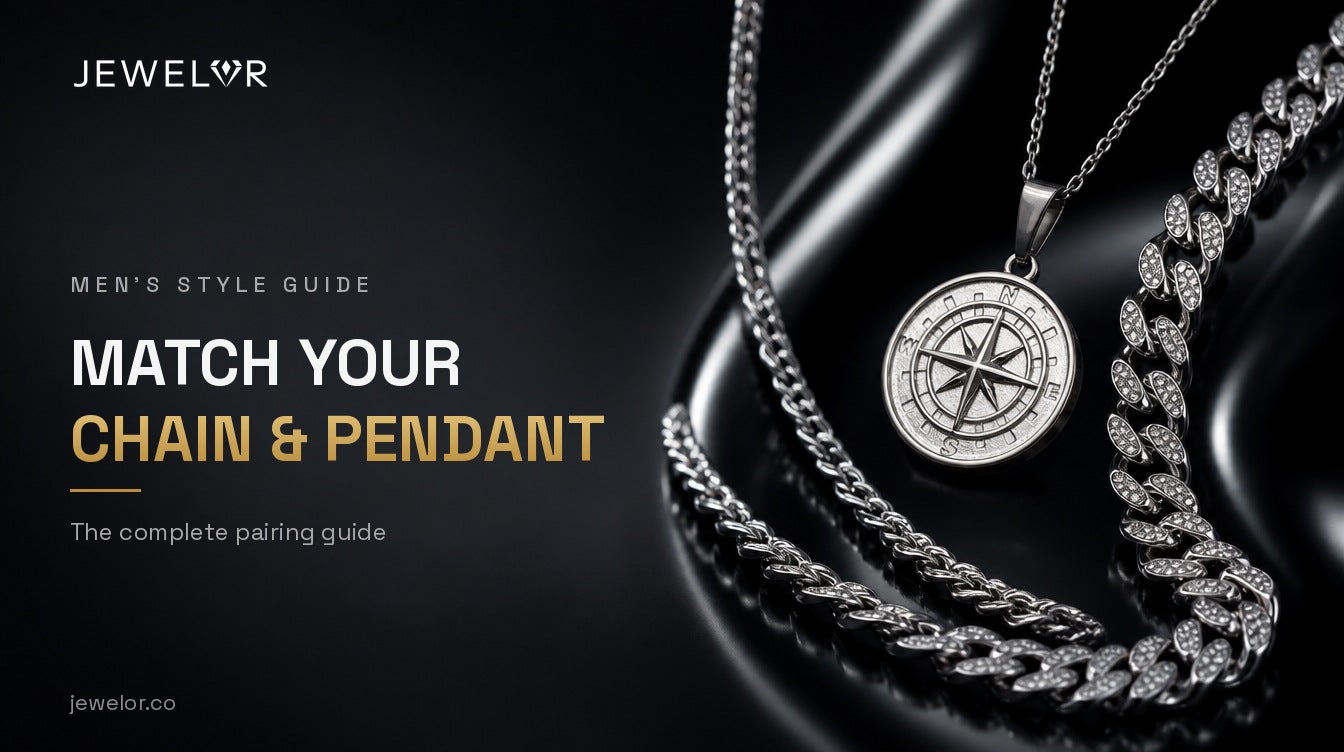
For a mid-weight pendant like our North Star Pendant (Silver), a 3–5 mm chain such as the Rope Chain (Silver) hits the sweet spot. Bolder pieces like the Midnight Skull Pendant (Black) deserve a wider, more substantial chain — a thick Cuban works brilliantly.
Rule 3: Choose the Right Length
Chain length changes where the pendant sits on your chest, which changes the entire look. Here is the conversion table we use, with typical Indian sizing alongside inches:
| Length (cm) | Length (inches) | Where it sits | Best for |
|---|---|---|---|
| 45 cm | 18" | Base of the neck / collarbone | Open collars, crew-neck tees |
| 50 cm | 20" | Just below the collarbone | The all-rounder — most pendants |
| 55 cm | 22" | Upper chest | Layering, over-shirt looks |
| 60 cm | 24" | Mid-chest | Hoodies, kurtas, statement pendants |
If you're between lengths, size up — a chain that sits slightly lower always looks better than one that chokes. And if you're buying online without trying anything on, 50 cm (20") is the safest single choice for a pendant chain: it works on most builds and over most necklines.
Quick self-measure: take a piece of string, drape it around your neck to where you want the pendant to sit, and measure the string with a ruler. Thirty seconds, and you'll never guess wrong again.
Rule 4: Keep the Motif in Focus
Let the pendant be the hero. This is the rule that separates a styled look from a cluttered one:
- Detailed or iced-out pendant → simple chain. If the pendant has stones, engraving, or a complex motif, pair it with a plain link or rope chain so the two don't compete.
- Minimal pendant → the chain can carry more presence. A simple bar or geometric plate looks sharper on a slightly thicker, textured chain that adds visual weight.
- One statement per neck. If the pendant is loud, everything else — chain, other accessories — stays quiet.
Explore the range in our pendants collection — from minimal silver pieces in the silver pendants line to bolder motifs in black pendants — and apply this rule to whichever direction you lean.
Match the Combination to Your Build and Neckline
Two quick adjustments make any pairing look tailor-made:
- Build: broader chests and shoulders carry wider chains and larger pendants naturally; on slimmer frames, the same pieces can look borrowed. If you're lean, shift one step down the width table — a 3–4 mm chain with a mid-size pendant usually photographs and wears better than the chunky option.
- Neckline: crew necks frame a 45–50 cm chain perfectly; open collars and kurta necklines want 50–55 cm so the pendant sits in the open V rather than under fabric; high collars and hoodies need 55–60 cm so the pendant is actually visible. If most of your wardrobe is one neckline, buy for that neckline first.
Layering: Two Chains Done Properly
Layering adds depth without needing a single expensive piece. The formula:
- Two lengths, 5–10 cm apart. A 45 cm chain over a 55 cm chain is the classic pairing. Any closer and they tangle; any further and they look unrelated.
- One pendant maximum. Put the pendant on the longer chain and keep the shorter one bare. Two pendants at different heights almost always fight each other.
- Vary the texture, not the colour. A rope chain over a box chain in the same finish reads as deliberate. Two different colours reads as chaotic.
Something like our Diamond Cuban Chain (Silver) worn short over a longer plain chain with a pendant is a layering combination that works for almost everyone.
Why the Material Underneath Matters: 316L Stainless Steel
Style rules only matter if the chain still looks good in month six. This is where material makes or breaks the combination.
Every Jewelor chain and pendant is made from 316L stainless steel — the same marine-grade alloy used in watchmaking and surgical instruments. Compared with the brass, copper and mystery "fashion alloy" pieces sold at similar price points, the difference shows up in three ways:
- No skin discolouration. The classic "my chain turned my neck green" problem comes from copper-based alloys oxidising against sweat. 316L doesn't contain the copper content that causes it, so it simply doesn't happen.
- Skin-friendly by design. 316L is widely used for piercings and medical implants precisely because it releases negligible nickel onto skin. If cheap chains have left you itchy before, the alloy — not "sensitive skin" — was probably the culprit. Nickel sensitivity is one of the most common contact allergies, and low-nickel-release steel is the practical answer.
- Anti-tarnish, even in Indian conditions. Humidity, sweat and daily wear are exactly what 316L was designed to resist. Our gold and black pieces use PVD (Physical Vapour Deposition) coating — a hard finish bonded to the steel in a vacuum chamber — which outlasts conventional electroplating by a wide margin, so the colour you buy is the colour you keep.
That's why a ₹599–₹999 Jewelor chain can be worn daily — gym, commute, monsoon — in a way a plated brass chain never survives.
Keeping the Combination Fresh: 60-Second Care
- After heavy-sweat days, rinse the chain in plain water and pat dry with a soft cloth.
- Store chain and pendant flat in a pouch — hanging is fine, but never leave them tangled in a pocket.
- Keep perfume and deodorant sprays off the metal; spray first, wear the chain after.
- A monthly wipe with a drop of mild soap in warm water restores the shine. Full details in our stainless steel care guide.
Quick Recommendations by Look
- Minimal / office: 2–3 mm silver chain, small geometric pendant, 45–50 cm.
- Everyday versatile: 4–5 mm chain, mid-size motif, 50 cm — if in doubt, start here.
- Streetwear / statement: 6 mm+ Cuban or rope chain, bold pendant, 55–60 cm, worn over dark layers.
FAQ
What chain length should I buy for a pendant?
For most men, 50 cm (20") is the safest choice — it places the pendant just below the collarbone, which suits most builds and necklines. Go 55–60 cm if you mainly wear hoodies or want the pendant to sit mid-chest, and 45 cm only if you prefer a high, close fit with open collars.
Can I wear a gold pendant on a silver chain?
You can, but it rarely looks intentional. Stick to one finish family, or limit yourself to two tones where at least one piece (ideally the pendant) is deliberately two-tone. Silver + black is the easiest mixed pairing to pull off.
Will a stainless steel chain turn my skin green?
No. Green discolouration comes from copper-based alloys (brass, cheap "gold-tone" metal) reacting with sweat. 316L stainless steel doesn't leach copper, so it won't stain your skin — and its low nickel release makes it suitable for most sensitive skin too.
How do I stop my pendant flipping to the back of the chain?
That's a weight-balance problem: the pendant is too light for the chain, or the bail is too wide. Match pendant weight to chain width (see the table above), and choose a bail that fits the chain snugly. A properly balanced combination stays front and centre on its own.